2 megatrends are converging to create a global opportunity for energy storage:
- Wind and Solar have become the most affordable means for adding new energy production to the grid
- Global demand for energy is increasing significantly thanks in large part to the proliferation of energy-intensive innovations like crypto currency and AI
Wind and Solar are affordable, clean, and lend well to flexible sizing of installations (especially solar). Systems can be scaled to provide energy for a single home to entire cities. One downside of wind and solar is the intermittent nature of their power generation. When the grid relies on solar, periods of low sunlight can lead to an energy undersupply and skyrocketing power prices. In a period of excess wind, grid operators can be challenged to find a place to offload a bumper crop of power without overloading its systems.
These problems can be mitigated by energy storage systems. Whether a collection of traditional batteries or systems that trap heat energy for long durations, energy storage helps smooth volatility in energy markets and extend the life of existing energy infrastructure. Over the past decade, investment has over-indexed on the increase of energy production assets meaning the global grid is currently under-protected; as the pace of variable renewable energy development quickens over the coming years the problem will get worse.
The IEA projects an additional 225 Gigwatts of wind and solar production capacity in the United States by 2028. China, the world’s leader in renewable energy production, has begun mandating new production capacity be matched with 15%-30% energy storage capacity. Adding another 35 to 70 GW of energy storage is no small feat. If the problem were to be solved exclusively with Battery Energy Storage Systems rough cost estimates indicate a $75B to $150B price range. [1]
As an MBA student at Yale SOM, I’ve been plugged into this energy storage problem for the past two years. Coursework focusing on how to finance renewable energy projects, experience helping classmates launch a robotics startup focused on testing solutions for EV battery packs, and a Summer Internship in Climate Tech VC seem to all have coalesced on this problem. As I enter my final semester of MBA (and think about my post-grad career) I’m still working on answers to questions like:
- How will we build a decarbonized global energy system?
- What technologies will we rely on?
- What are the investment opportunities?
This piece is a quick download on large-scale battery solutions I’ve investigated thus far.
Battery Electric Storage Systems (BESS)
Battery Electric Storage Systems (BESS) provide grid-scale energy storage via very large and/or a collection of very large batteries to store excess electricity generated during periods of low demand and release it during peak hours. Today, most of these batteries are Lithium-Ion. Basically, these are giant versions of the batteries in your iPhone, Laptop, or EV that get charged up when energy is abundant and depleted when it is scarce. These systems are particularly good for short-term storage in the 4-12hr range which helps mitigate the challenges of the Duck Curve.
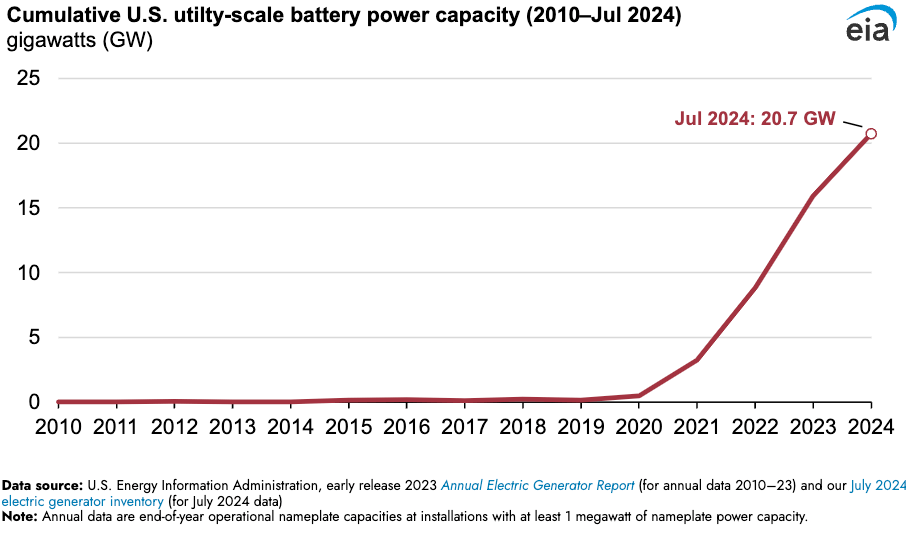
Thanks to its proven capabilities, a market flooded with relatively cheap Chinese Lithium-Ion batteries, and high modularity, BESS is growing rapidly. In July 2024, more than 20.7 GW of battery energy storage capacity was available in the United States; the IEA predicts this number could more than double by EOY 2025. [2]
Company Spotlight
Goshe Energy Storage (“Goshe”, pronounced GO-shee) advances a sustainable energy future by developing, building, and operating utility-scale energy storage projects with a special focus in Texas/ERCOT. Goshe is an independent power producer (IPP) with a roughly 2.6 GW pipeline of battery storage projects, including four projects totaling around 630 MW/1,280 MWh that will be under construction by 2Q25. [3] I had the pleasure of chatting with Goshe CEO Bailey McCallum in the Summer of 2024 and thought there was incredible promise for this business based on the macro-demand for storage and the smart market penetration strategy (ERCOT’s largely deregulated nature means the greatest excess profits are possible within this ISO). Apparently, others agreed as an update from November 2024 indicates Goshe is in conversations for an up-to-100% buyout based on the strength of their financial projections for 2025 and 2026.
Coordinated Battery Resources
Taking a page from the AirBnB playbook, Coordinated Battery Resources rely on existing energy storage devices typically owned by private entities (IPPs or even individual home/EV owners). These solutions may offer rapid scaling as they focus on network development, offboarding the onus of physical asset development and maintenance.
VPP
Virtual power plants (VPPs) are systems that aggregate distributed energy resources like solar panels, wind turbines, and battery storage. VPPs operate as a network coordinated by advanced control systems. Imagine a neighborhood where every home has rooftop solar and a Tesla power wall. Homeowners give control of their system to the VPP which can charge/uncharge the battery as needed to balance grid-level demand. VPPs are operating on smaller-scale, pilot-type agreements today in places like California and Hawaii.
Company Spotlight
Shifted Energy is a Hawaiian startup which specializes in low-cost, control service products that allow devices ranging from water heaters, solar panels, power walls and more to be aggregated into VPPs. Shifted is a portfolio company of Skyview Ventures where I interned in the Summer/Fall of 2024. As VPPs come to the fore of the global energy storage solution set, companies like Shifted are an interesting ‘picks and shovel’ type investments.
V2G
Vehicle-to-Grid (V2G) technology enables bidirectional energy flow between electric vehicles (EVs) and the power grid. V2G allows EVs to act as mobile energy storage units, charging during low-demand periods and feeding electricity back to the grid during peak times. Much like VPPs, V2G is a creative means of shifting the burden of asset ownership, in this case to the growing ranks of EV owners, and paying the owners for their service. V2G is particularly interesting when we think of the electrification of medium and heavy-duty vehicles. Imagine a lot full of Electric School buses parked between the morning and afternoon routes- these big-battery vehicles will be available for charging at peak output for solar. They can plug back into the grid for discharge right as people return home for work.
Company Spotlight
Fermata Energy is a V2X (vehicle-to-X) company that provides bi-directional EV chargers and a managed EV charging service. In tandem, these solutions allow EV owners to charge when energy is cheap, discharge when energy demand is on the rise, and ensure that the vehicle owner has sufficient power to go about her daily logistics. Another Skyview Ventures portco, I am inspired by Fermata’s thrust to build a vertical product set across hardware and software that allows millions of big EV batteries to do more for their owners and the grid at large.
New Battery Tech
Lithium-Ion is undoubtedly the ‘battery of today.’ Li-Ion offers impressive energy density and can be flexibly designed to power devices ranging from iPhones to Drones to grid-scale BESS. But it’s probably time to hedge our exposure to Li-Ion. The earth’s supply of Lithium, Nickel, Cobalt, and Rare-earth elements, key components in Li-Ion batteries, have been dominated by nations adversarial to the United States, especially China. China has also aggressively scaled its Li-Ion production complex, flooding the global market with cheap batteries that reduce the impetus for private-sector investment in battery production or materials innovation. As we start 2025, fears of trade wars and increasing geopolitical tension threaten our long-term capabilities to electrify Western economies.
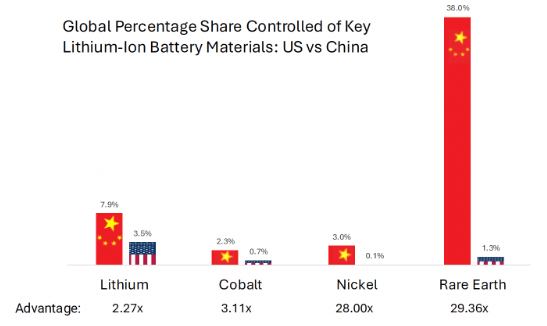
Here’s a snapshot of some other battery types in development. Some offer the potential to replace Li-Ion entirely, while others could diversify chemical energy storage with systems made of easier-to-source materials.
Solid-State Batteries
| Deployment Status | Problems Solved | Application(s) |
| Research and Development | Upgrade to Li-Ion w/ respect to charge times, energy density | Everything from small consumer electronics (like cell phones), EVs, to grid-scale installations |
Solid-state batteries are an emerging technology that replaces liquid electrolytes with solid materials. They’re exciting because they promise higher energy density, faster charging, improved safety, and longer lifespan compared to traditional lithium-ion batteries. This technology may supplant Lithium-Ion as it is scalable from the size of iPhone to a grid-scale BESS. For the EV market, it’s estimated that a solid-state battery could achieve a full charge at a DC Fast Charger in about 10 minutes compared to the expected 40 minutes of a lithium-ion platform. [4]
Flow batteries
| Deployment Status | Problems Solved | Application(s) |
| Limited project-level deployments and pilots | Reduce demand for difficult-to-mine natural resources | Grid storage, large-scale storage for homes and businesses |
Flow batteries rely on the passing of ions across a membrane between 2 usually liquid electrolytes. If tank 1 contains a positively charged solution and tank 2 has a negatively charged solution, ions will pass through the membrane seperating the tanks and create electricity. These batteries excel in grid-scale applications, supporting renewable energy integration with long-duration storage capabilities. What’s most interesting about these battery types is they are very easy to scale up- increasing storage capacity is just a function of bigger tanks of electrolytes.
Flow batteries offer long lifespans, high safety, and potential for low costs- while today’s most energy-dense flow batteries rely on Vanadium, a difficult to source resource, experiments with electrolytes based on readily available resources like Sodium are showing promise.
Company Spotlight
Form Energy is a leading company in the development of iron-air long-duration energy storage solutions. Form began trial production at its Factory 1 in West Virginia in September 2024 and has announced pilot projects across the United States representing over 14 GWh of storage in aggregate. Form has raised over $1.2B dollars in funding.
Zinc-based batteries
| Deployment Status | Energy Duration | Energy Scale |
| Limited project-level deployments and pilots | Cheaper material costs than Li-Ion | Grid storage, large-scale storage for homes and businesses |
Zinc batteries function similarly to Lithium-Ion batteries but substitute materials in the anode, cathode, and electrolyte with materials that are easier to source and more environmentally friendly. While zinc batteries offer improved safety, lower costs, and environmental benefits compared to lithium-ion batteries they are less efficient than Li-Ion systems and are likely only applicable in situations like grid-scale where battery smallness is not of ciritical importance.
For this author, zinc batteries are not particularly exciting- marginal improvements to safety and end-of-life recyclability are not attractive-enough reasons to scale Zinc-Ion production to reach cost parity with Lithium-Ion. Furthermore, Zinc is subject to unfavorable natural resource distribution similar to Li-Ion. Increases in geo-political tension could strain the Zinc battery supply chain.
Wrapping Up
More renewable energy, more crypto trading, and more AI all point to a global energy system that will rely on a lot more energy storage. In this piece, I’ve focused on the battery solution set. It’s important to mention: batteries are not the only way to solve grid-scale storage problems. Pump Hydro Storage, a system devised to accommodate Nuclear power generation in the 20th century, is currently the largest battery storage solution by capacity in the United States. Other companies are innovating new ways to store energy in thermal and mechanical forms that have promising initial results with respect to round trip energy efficiency. Perhaps I’ll return to the energy storage topic to cover these concepts as I continue my research.
Citations
[1] Assumes $526 per kwh, (from UtilityDrive, New York energy storage additions since 2018 approach 1 GW: report) and a 4hr duration (140 GWh system to 280 GWh).
[2] EIA, Batteries are a fast-growing secondary electricity source for the grid
[3] Ion Analytics, Sale process launched for battery developer
[3] TopSpeed, How Samsung’s 600-mile Solid-State Battery Differs From Lithium-ion Batteries
[5] E+E Leader, Will Iron-Air Batteries Revolutionize Renewable Energy Storage?
 Shane Wilson's Blog